Home
/ How To Subtract Fractions, Add And Subtract Fractions 1 Homework Extension Year 6 Fractions Classroom Secrets : Write the answer and place it over the denominator.
How To Subtract Fractions, Add And Subtract Fractions 1 Homework Extension Year 6 Fractions Classroom Secrets : Write the answer and place it over the denominator.
How To Subtract Fractions, Add And Subtract Fractions 1 Homework Extension Year 6 Fractions Classroom Secrets : Write the answer and place it over the denominator.. Find the lowest common multiple of the denominators. Determine the lcm of the denominators, 9 and 16. Once you've mastered adding fractions, subtracting fractions will be a breeze! Let's start with an easier one first. Adding and subtracting mixed fractions.
Write the common denominator as the denominator of the resultant fraction. Multiply the second numerator by the first denominator. Check to see if the fractions have the same denominator. Rewrite the fractions with the new common denominator. Similarly, we can perform subtraction operations on fractions.
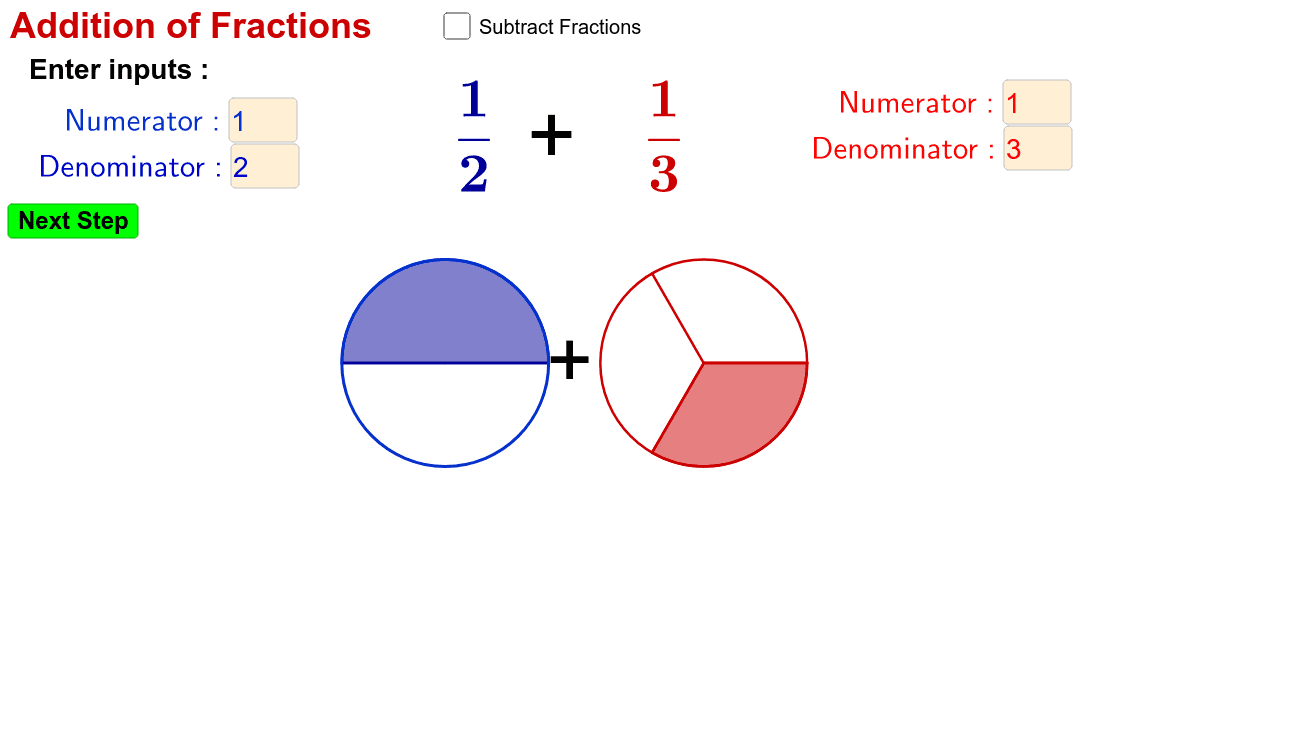
Illustrating Addition And Subtraction Of Proper Fractions Geogebra from www.geogebra.org When applied to fractions this number is called the lowest common denominator (lcd) of the fractions.; Multiply the two denominators together to find the denominator of the answer. You can either convert the whole number into a fraction, or subtract 1 from that whole number and convert the 1 into a fraction with the same base as the fraction you're subtracting from it. Let us subtract the fractions 4/5 and 2/5 using rectangular models. Subtracting fractions is a lot like regular subtraction. Find a common denominator by multiplying the two denominators together. Let's start with an easier one first. You just need to subtract the numerators and leave the denominator unchanged.
First, start by subtracting the fractions, ensuring they have the same.
Given a fraction written in the form a/b, the top part (a) is called the numerator, and the bottom part (b) is called the denominator. Check to see if the fractions have the same denominator. Solving subtraction problems with fractions. For like fractions (fractions with the same denominator), add or subtract the numerators and write the answer over the common denominator. To add or subtract fractions don't have equal denominators, they must first be converted to equivalent fractions that do have a common denominator. 2/5 ÷ 2/3 = 2/5 x 3/2 = 6/10 List the prime factors of both numbers: The method is just the same, except now you may need to add negative or positive numerators. Similarly, we can perform subtraction operations on fractions. Jetzt eine riesige auswahl an gebrauchtmaschinen von zertifizierten händlern entdecken. Friktion beim führenden marktplatz für gebrauchtmaschinen kaufen A mixed fraction is a. There are two main ways to go about it:
To add the fractions with unlike denominators, rename the fractions with a common denominator. Subtract the numerators and keep the denominator the same. Whole number and a fraction combined, such as 1 3 4. A mixed fraction is a. Manipulate the fractions so that they both have the.
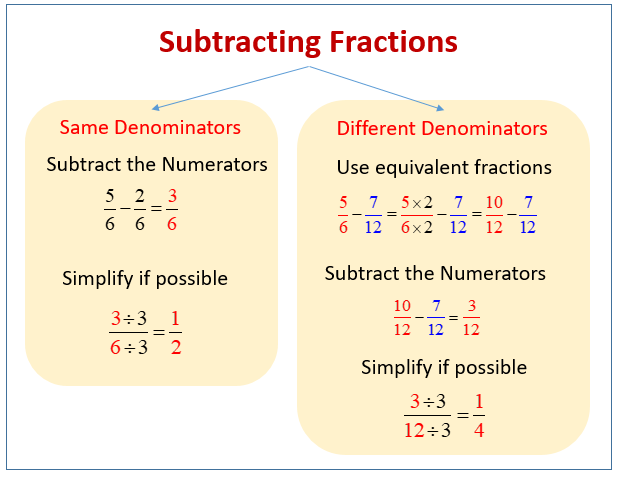
Subtracting Fractions Examples Solutions Videos from www.onlinemathlearning.com Let's start with an easier one first. For like fractions (fractions with the same denominator), add or subtract the numerators and write the answer over the common denominator. You can either convert the whole number into a fraction, or subtract 1 from that whole number and convert the 1 into a fraction with the same base as the fraction you're subtracting from it. Once they have the same denominator, add or subtract the numbers in the numerator. Rewrite the fractions with the new common denominator. For example, the subtraction of 3 from 5 results in 2. An improper fraction has a. You just need to subtract the numerators and leave the denominator unchanged.
Enter fractions and press the = button.
The difference must be entered as a mixed number and in lowest terms. Subtracting fractions from whole numbers isn't as hard as it looks. Whole number and a fraction combined, such as 1 3 4. Whether you're adding, subtracting, multiplying or dividing fractions, you should always aim for the tidiest answer possible. The first step to dividing fractions is to find the reciprocal (reverse the numerator and denominator) of the second fraction. Enter fractions and press the = button. To add the fractions with unlike denominators, rename the fractions with a common denominator. Determine the lcm of the denominators, 9 and 16. The lcm of 5 and 3 is 15. Tell your fraction if its bum looks big in this and simplify it down to the smallest option (e.g. Write the answer and place it over the denominator. Then subtract the numerators by keeping the denominator constant. Convert each fraction to an equivalent fraction that has the lcd as.
To subtract fractions using the butterfly method, follow these steps: When applied to fractions this number is called the lowest common denominator (lcd) of the fractions.; Find a common denominator by multiplying the two denominators together. For example, the subtraction of 3 from 5 results in 2. Write the answer and place it over the denominator.
How To Add And Subtract Fractions The Easy Way Youtube from i.ytimg.com Top number larger than or equal to. Determine the lcm of the denominators, 9 and 16. Choose a common denominator for the fractions by finding least common multiple of the denominators. Adding and subtracting mixed fractions. Let's say you need to subtract 1 and 1/4 from 3 and 3/4. To subtract mixed numbers, subtract the whole number parts of the mixed numbers and then subtract the fraction parts in the mixed numbers. Tell your fraction if its bum looks big in this and simplify it down to the smallest option (e.g. Finally, combine the whole number answer and the fraction answer to express the answer as a mixed number.
Subtracting a fraction from a mixed number.
Find equivalent fractions with the same denominator before you can add or subtract fractions with different denominators. The steps to subtract fractions are very similar to those for adding or comparing fractions (not surprising, as subtracting is just adding a negative!). The steps we follow to subtract fractions with variables are as follows: You can see that the denominators are not the same, so let's get to work on adjusting one or both fractions so their denominators match. Then, multiply the two denominators. Finally, combine the whole number answer and the fraction answer to express the answer as a mixed number. Note that the fractions have the same denominators and the first fraction is larger than the second: Add the result to the whole number you wrote earlier: Write your answer with the new numerator over the denominator. The lcm of 5 and 3 is 15. 2/5 ÷ 2/3 = 2/5 x 3/2 = 6/10 Then subtract the numerators by keeping the denominator constant. The first step to dividing fractions is to find the reciprocal (reverse the numerator and denominator) of the second fraction.